
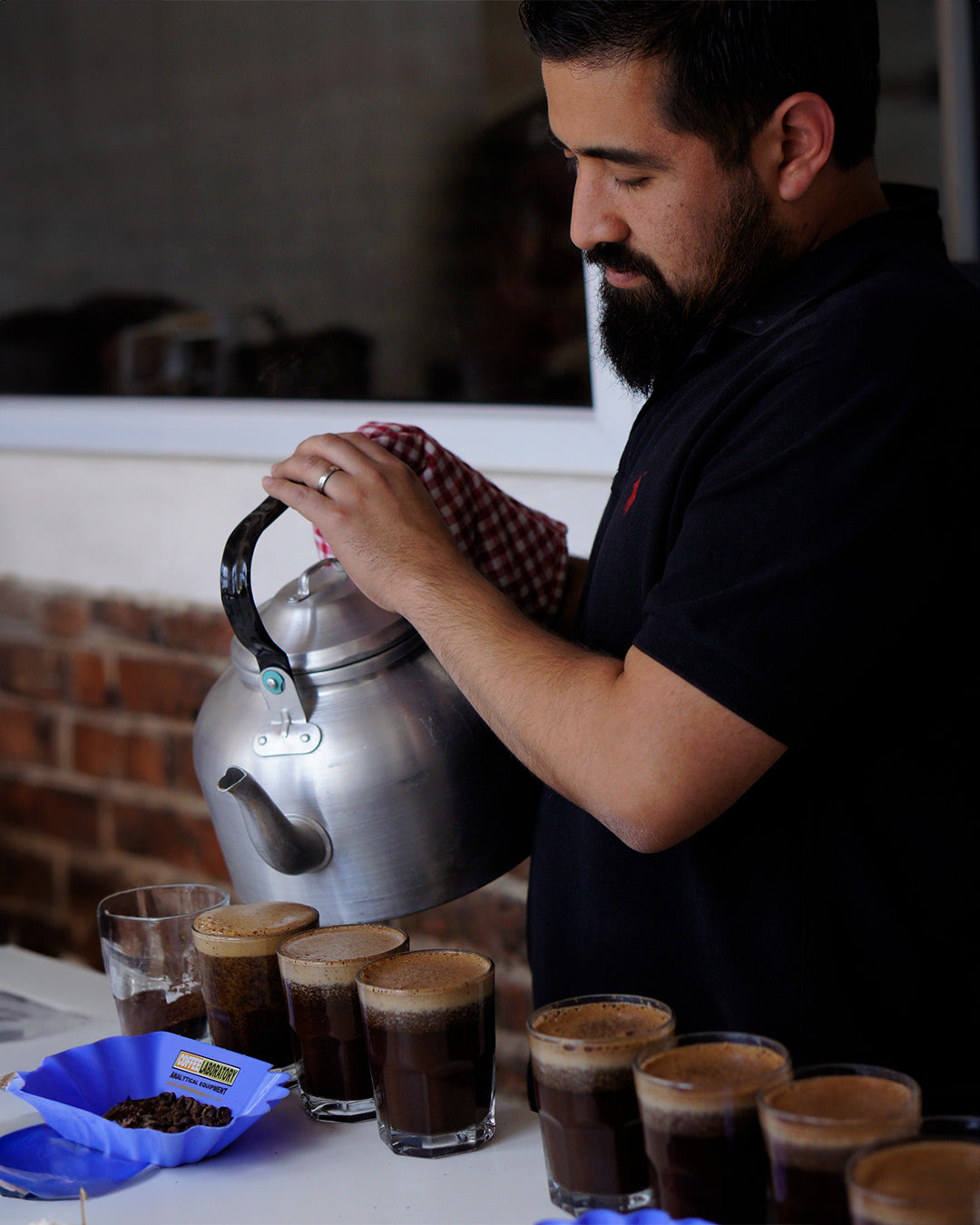

What is Coffee Cupping?
Cupping is something coffee professionals do to evaluate a coffee. It involves a line of cups, several samples from one batch of coffee, and a trained tasting palette. Don’t worry, we’ll give you some beginner tips below.
Cupping is important in the coffee industry because it is a quantifiable way to grade coffees. It’s how the coffee pros check for uniformity in coffee batches and detect defects. It helps guarantee a coffee has a consistent profile from farmer to roaster. And it’s the global standard for coffee grading. In other words, cupping allows us to all speak the same coffee language.
The guy you’ll find cupping coffee on the daily at DOMA is Ian, our director of quality control. That’s a big title, but it just means he’s our favorite coffee nerd. Or, more precisely, it means Ian has spent years training his coffee palette to distinguish the most subtle qualities in a coffee. He’s SCA certified (woot!) and he’s the one you’ll see in our how-to video below.
While evaluating a coffee’s consistency during cupping, Ian begins to form an impression of the coffee’s inherent profile. He takes note of the coffee’s aroma, flavor, body, aftertaste, acidity and overall balance. This is the part that you can do at home.
Why We Do It
When we go to Origin, which is when we travel to farms and mills in coffee-producing countries like Guatemala, we use cupping as a tool to evaluate and connect. It allows us to sample fresh crops, strengthen our sourcing relationships and calibrate with our producing partners so they know what we’re looking for in a coffee.
Here’s a fun example: If we’re cupping next to a producer and we taste lime, but they taste citrus, we know to look for coffees with citrus notes from their farm to source for coffees we want to have a hit of lime. We work to keep a consistent profile in our DOMA blends across coffee seasons, so when you buy DEEP coffee, it always tastes like DEEP coffee.
At Origin, we often cup a couple of times a day with upwards of 20 offerings on the table, three cups per offering. (It's a tough job, but someone has to do it.) This is the part of the coffee sourcing experience that feels like breaking bread with our producing partners. It’s a shared experience that is fun, exploratory and challenging. That’s the part we want to bring you in on at home.
Getting Started
We use multiple cups of the same coffee while cupping so we can check for uniformity. Since we’ve already done this for any bag of DOMA coffee you’ll be trying at home, you can practice your tasting with just a single coffee sample, cup and spoon. Or, try a side-by-side cupping with different coffees to exercise your coffee tasting palette.

Here’s a list of materials you’ll need to cup coffee at home:
· Tasting Spoon
· Cup of Water
· Fresh Beans
· Coffee Grinder
· Scale
· Cups for Coffee Samples
· Water Kettle
· Timer
Once you have those items, it’s time to dive in with Ian!
Press play on the video below and follow along. We’ll also link to the official SCA Guide for cupping coffee and how we create tasting notes so you can really do a deep-dive.
Here's to getting to know your coffee better. It's a fun place to be.


Learn more about aroma, flavor, aftertaste, acidity, body, balance and how we create our tasting notes.